
H2S Detection · Abu Dhabi & UAE-Wide Supply
H2S Gas Detectors & Personal H2S Monitors for UAE Sites
On a sour-gas site the danger isn’t the rotten-egg smell — it’s the moment the smell goes away. Around 100 ppm, hydrogen sulphide knocks out the sense of smell within minutes, so the gas seems to “clear” exactly when it is at its most dangerous. A personal H2S gas detector has no such blind spot. Clipped at the collar, it reads the air the wearer is breathing and alarms with sound, light and vibration the instant the level crosses its set point.
BN International General Trading supplies H2S detectors from Al Nahyan, Abu Dhabi, to crews across the UAE: the SENKO SP-SGT, documented clause by clause against ADNOC’s HSE-OS-ST20 §9.8 personal H2S detector specification, and the Honeywell BW Clip in 2-year and 3-year versions. Real-time, serviceable and fixed H2S detection is sourced to order. This range sits within our wider gas detectors line.
Personal H2S detectors for UAE crews
The four clip-on lines UAE contractors issue most. Every unit is intrinsically safe, alarms at 10 and 15 ppm out of the box, and ships with its certificates and serial numbers.
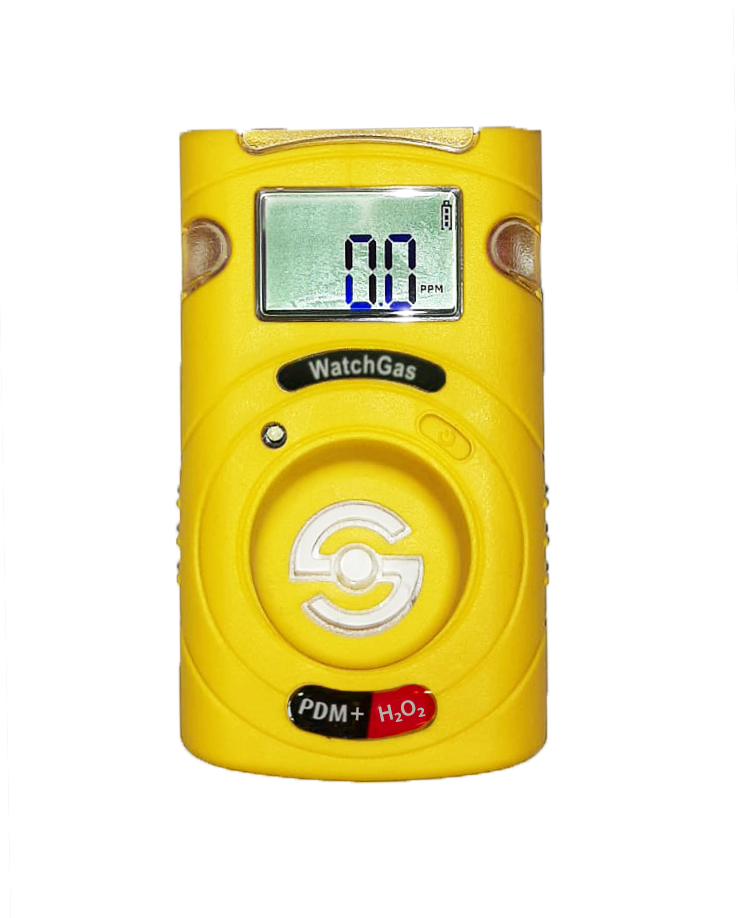
SENKO SP-SGT H2S Personal Detector
Disposable 24-month clip · 0–100 ppm · 10/15 ppm alarms · IP67 · ATEX/IECEx/CSA · ADNOC §9.8 compliance sheet
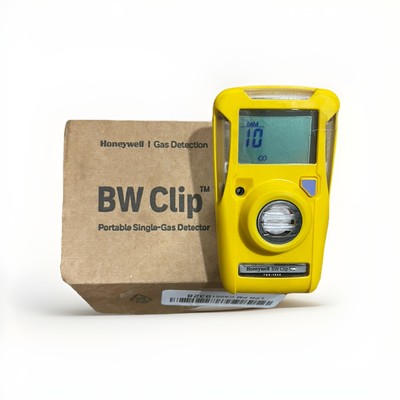
Honeywell BW Clip H2S — 2-Year (BWC2-H)
2 years from activation · 0–100 ppm · 95 dB · IP66/67 · ATEX/IECEx
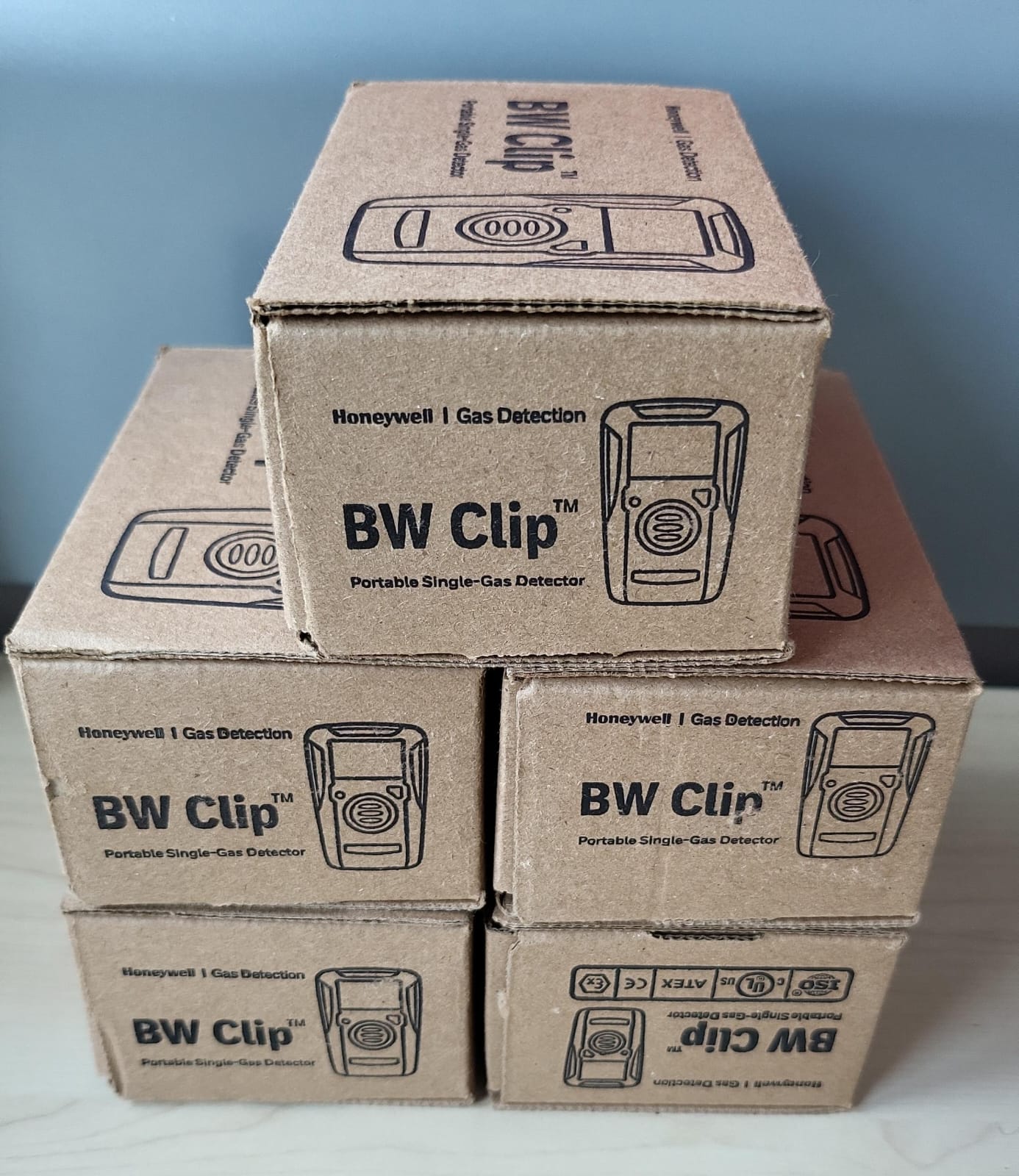
Honeywell BW Clip H2S — 3-Year (BWC3-H)
Longest disposable life · Surecell sensor · 10/15 ppm alarms · ATEX/IECEx
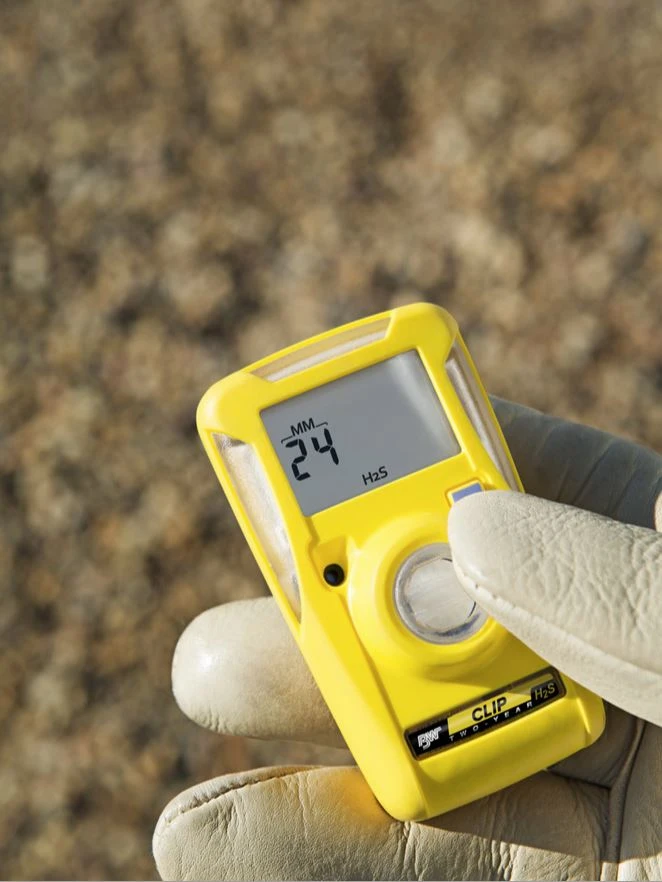
Honeywell BW Clip Real Time H2S
Live ppm display · calibratable · bump & calibration reminders · ATEX/IECEx
The full H2S detector range — stocked and sourced
Every H2S line we supply, from disposable clips to fixed transmitters. Core range lines are the ones we move most; the rest are sourced on request, with the lead time stated up front.
Product | Type | Life / servicing | Key spec | Certification | Supply |
|---|---|---|---|---|---|
| SENKO SP-SGT H2S Personal Detector | Disposable personal clip | 24 months, maintenance-free | 0–100 ppm · 0.1 ppm resolution · 10/15 ppm alarms · IP67 · 93 g · 30-event log | ATEX · IECEx · CSA/UL-913 | Core range |
| Honeywell BW Clip H2S — 2-Year (BWC2-H) | Disposable personal clip | 2 years from activation; hibernation case extends it | 0–100 ppm · 10/15 ppm · 95 dB · IP66/67 · 92 g · 35-event log | ATEX · IECEx · Class I Div 1 | Core range |
| Honeywell BW Clip H2S — 3-Year (BWC3-H) | Disposable personal clip | 3 years from activation | Same Surecell sensor and alarms, the longest disposable life | ATEX · IECEx · Class I Div 1 | Core range |
| Honeywell BW Clip Real Time H2S | Personal clip with live display | Calibratable | Live ppm reading on screen · bump and calibration reminders | ATEX · IECEx | Core range |
| SENKO SP-SGT Sampling Pump + 5 m / 10 m Extension Probe | Accessory | — | Draws air from a hatch or manhole into the SP-SGT for H2S spot checks | — | To order |
| Crowcon Clip SGD H2S | Disposable personal clip | 2-year, maintenance-free | Crowcon’s sealed H2S clip | ATEX · IECEx | To order |
| Honeywell BW Solo H2S | Serviceable single-gas | Replaceable sensor and battery | Standard or extended-range H2S sensor | ATEX · IECEx · CSA | To order |
| MSA ALTAIR 2XP H2S | Serviceable single-gas | Replaceable sensor | XCell Pulse sensor with gas-free self-check | ATEX · IECEx | To order |
| Dräger Pac 6500 H2S | Serviceable single-gas | Replaceable sensor and battery | Rugged housing, event logging | ATEX · IECEx | To order |
| Industrial Scientific Tango TX1 H2S | Serviceable single-gas | Replaceable sensors | DualSense: two H2S sensors in one unit | ATEX · IECEx | To order |
| Honeywell RAE ToxiRAE 3 H2S | Serviceable single-gas | Replaceable sensor and battery | Compact, data-logging H2S monitor | ATEX · IECEx | To order |
| Honeywell Sensepoint XCD H2S | Fixed transmitter | Field-replaceable sensor cartridge | 4–20 mA output, local display: pump rooms, process areas | ATEX · IECEx (flameproof) | Project supply |
| Crowcon Xgard Type 1 H2S | Fixed detector | Replaceable sensor module | 0–100 ppm, for hazardous-area installation | ATEX · IECEx | Project supply |
| H2S Bump-Test Gas & IntelliDoX Dock | Test & maintenance | — | Certified H2S test gas for daily checks; IntelliDoX automates and records BW bump tests | — | To order |
Why no prices? Regional shipping and supply disruption is moving freight and stock costs week to week, so we quote at the current rate on the day you ask rather than list a price that may not hold.
Not sure which one? Send the job, the headcount and any project spec you must meet.
Disposable, real-time, serviceable or fixed — which H2S detector fits the job?
Every unit above detects the same gas. The real choice comes down to how long it lasts, what it shows the wearer, and who maintains it:
- Disposable 2- or 3-year clip (SENKO SP-SGT, BW Clip H2S). One detector per worker, zero maintenance? Switch it on, wear it, and replace the whole unit when the counter runs out. There are no sensor swaps, no charging and no calibration. This is what most UAE oil & gas contractors issue to everyone on the plot. On an ADNOC site, the SP-SGT is the straightforward pick.
- Real-time clip (BW Clip Real Time). Does the wearer need to see the actual ppm? The same clip with a live reading and calibration, suited to supervisors, permit issuers and gas testers.
- Serviceable single-gas (BW Solo, ALTAIR 2XP, Pac 6500, Tango TX1, ToxiRAE 3). Heavy daily use for years? A higher initial spend, but you replace the sensor, not the device, and extended-range sensors are available above 100 ppm.
- Fixed H2S detector (Sensepoint XCD, Xgard). Is the risk tied to a place rather than a person? These watch a pump room, wet well or process area around the clock.
For a confined-space entry, H2S is only one of four gases to watch. That job needs a 4-gas detector, with the H2S clip worn as a second layer.
What hydrogen sulphide does at each concentration
The gap between “unpleasant” and “fatal” is shorter than most people expect, which is why a personal monitor alarms at 10 ppm instead of waiting for symptoms.
H2S level | Effect on the body |
|---|---|
| 0.01–1.5 ppm | Rotten-egg smell becomes noticeable |
| 2–20 ppm | Nausea, watering eyes and headaches with prolonged exposure |
| 50–100 ppm | Eye and airway irritation; at 100 ppm the sense of smell is lost in 2–15 minutes (IDLH) |
| 500–700 ppm | Staggering and collapse within about 5 minutes |
| 700–1,000+ ppm | “Knockdown” within one or two breaths; breathing stops |
Levels follow the US OSHA hydrogen sulphide fact sheet; individual response varies.
At about 1.19 times the density of air, H2S settles into pits, trenches, wet wells and tank bottoms, which are often the places people climb into. A personal clip reads 0–100 ppm, so an over-range reading means the wearer must leave now, not investigate.
How an H2S gas detector works — and where to wear it
Almost every portable H2S monitor uses an electrochemical sensor. H2S diffuses through a membrane into a small cell and reacts at an electrode, producing a current in proportion to the gas level. The detector converts that current to ppm and alarms when a set point is crossed. Honeywell’s BW Clip uses its Surecell™ dual-reservoir cell, built to hold performance in heat and humidity, and SENKO’s SP-SGT reads to 0.1 ppm. Both run automatic self-checks on their electronics, but only a bump test proves the sensor still responds to gas.
Where to wear it: in the breathing zone, meaning the collar, a chest strap or the front of the coverall, within a hand-span of the nose and mouth. Avoid the belt, which samples air a metre from where you breathe, and never clip it inside clothing, where the alarm is muffled and the sensor is blocked.
H2S gas detector alarm levels — 10 ppm, 15 ppm, and when to set them lower
Both the SENKO SP-SGT and the Honeywell BW Clip ship with a low alarm at 10 ppm and a high alarm at 15 ppm. The right set points, though, are the ones your HSE plan is written to.
Reference | Value | In practice |
|---|---|---|
| Factory low alarm | 10 ppm | Stop work, move upwind, prepare to leave |
| Factory high alarm | 15 ppm | Evacuate to the muster point |
| ACGIH TLV | 1 ppm TWA · 5 ppm STEL | The benchmark many international operators align to |
| UK EH40 WEL | 5 ppm TWA · 10 ppm STEL | Used by UK-standard contractors |
| IDLH | 100 ppm | Top of a personal clip’s range |
Set points are adjustable: on the BW Clip before or after activation, and on the SP-SGT through the IR link or docking station. Sites working to ACGIH commonly set the low alarm at 5 ppm. Include the set points your permit requires when you enquire, and we’ll confirm the configuration in the quote. On a high alarm, the procedure is to leave, not troubleshoot, and on sour-gas plots that often means pulling on an emergency escape set on the way out.
Where H2S turns up on UAE sites
H2S comes from two sources: sour hydrocarbons, and organic matter breaking down without oxygen. In the UAE, that puts it in these places:
- Sour-gas fields and gas processing: Shah, Bab and Habshan. The Shah development is one of the world’s largest sour-gas projects, and every person on the plot wears a personal H2S monitor.
- Refining and sulphur recovery: Ruwais refinery, sulphur pits and tank gauging, with personal clips backed by fixed detection.
- Offshore, drilling and well services: well testing, mud returns, workovers and pigging.
- Sewers, deep tunnels and wastewater: Abu Dhabi’s STEP deep tunnel, pumping stations, wet wells, manholes and treatment plants.
- Marine and tank cleaning: crude cargo tanks, bilges and sewage tanks at Mussafah, Khalifa Port, Jebel Ali and Hamriyah.
- Landfill, compost and agriculture: decomposing waste and manure pits, where gas builds quietly in enclosed areas.
ADNOC HSE-OS-ST20 §9.8 — the personal H2S detector specification
Section 9.8 of ADNOC’s PPE specification HSE-OS-ST20 sets what a personal H2S detector supplied to its sites must do, and contractors’ purchase orders often quote it by clause. Here is how the two disposable lines compare.
§9.8 requirement | SENKO SP-SGT (supplier compliance sheet) | Honeywell BW Clip H2S (published datasheet) |
|---|---|---|
| Disposable, maintenance-free — no sensor or battery changes | Confirmed | Yes |
| Operating life 24 or 36 months | 24 months | 2-year or 3-year versions |
| Shelf life 12 months | Supplier recommends use within 6 months | 1 year before activation |
| Ambient −40 to +50 °C (H2S) | Confirmed | −40 to +50 °C |
| H2S range 0–100 ppm | Confirmed | 0–100 ppm |
| Low/high alarms — visual, audible (90 dB), vibration | Confirmed | Visual, vibrating, 95 dB |
| Configurable alarm set points | Yes | Adjustable before and after activation |
| IP66/67 | Confirmed | IP66/67 |
| 30 most recent events logged | Confirmed | 35 events |
| UL-913 & CSA C22.2 No.157 · ATEX II 1G Ex ia IIC T4 Ga · IECEx Ex ia IIC T4 | Confirmed | ATEX, IECEx, Class I Div 1 |
| Unique serial number on each label; sensor serials on the certificate | Confirmed | Serial-labelled; certificate format confirmed per order |
The SENKO column comes from the supplier’s clause-by-clause compliance sheet, which we send with every SP-SGT quotation. The Honeywell column comes from Honeywell’s published datasheet, not from an ADNOC-issued document. Acceptance on any ADNOC site is decided by ADNOC and the site HSE team, so send us the exact clause wording from your PO and we’ll match the documentation to it.
Certificates supplied with the SENKO SP-SGT
- ATEX: EU-Type Examination Certificate KRH 16 ATEX 1048, marked II 1 G Ex ia IIC T4 Ga (Directive 2014/34/EU).
- IECEx: IECEx KTL 15.0018 (Korea Testing Laboratory), Ex ia IIC T4 Ga. You can check its current status on iecex.com.
- CSA / UL: Certificate 70093757, Class I Division 1 Groups A–D T4, and Class I Zone 0 AEx ia IIC T4 Ga, to UL 913 and UL 60079.
The Honeywell BW Clip carries ATEX II 1G Ex ia IIC T4 Ga, IECEx Ex ia IIC T4 Ga and Class I Div 1 Groups A–D, plus American Bureau of Shipping approval, which is useful for marine and offshore buyers.
Project supply
Fixed H2S gas detectors and installation height
A personal monitor protects the person wearing it. A fixed H2S detector protects a place where a leak could start with nobody nearby, such as a compressor shelter, sulphur pit, wet well or pump room. It sends a 4–20 mA signal to a control panel that can sound alarms, start ventilation or trigger a shutdown.
On installation height: H2S is heavier than air, so sensors are generally mounted low and close to likely leak points. Hot or high-pressure releases can rise before they settle, though, and some layouts add a sensor at breathing height. Final positions therefore come from the site’s gas-mapping layout, not a single rule. We supply fixed H2S detection to order, quoted per project, with datasheets and certificates for engineering approval.
Keeping an H2S detector reliable
- Bump test before each day’s use. Expose the unit to a known concentration of H2S and confirm that it reads and alarms. An IntelliDoX dock automates this for BW units and records every result. Re-test after any drop, soaking or high exposure.
- Disposable clips need no calibration for their 2- or 3-year life. Real-time and serviceable units are calibrated on the manufacturer’s schedule, and immediately after a failed bump test.
- Order close to mobilisation. An unactivated BW Clip keeps for one year, and SENKO advises using the SP-SGT within six months. We supply fresh-dated stock so that crews don’t lose life on the shelf.
Why HSE and procurement teams order H2S detectors from BN International General Trading
With every order we send the paperwork an auditor asks for: SENKO’s §9.8 compliance sheet, the ATEX, IECEx and CSA certificates for the exact model, and unit serial numbers for your detector register. We tell you plainly what is on the shelf and what is sourced, with the lead time.
We supply single units through to full project quantities from our Al Nahyan office (ADRA licence CN-6387714), delivering to Ruwais, Mussafah, ICAD, KEZAD, Jebel Ali, Hamriyah and every emirate. Payment is by cash on delivery, bank transfer, or corporate invoicing for account customers.
One thing we don’t sell is the cheap handheld “H2S tester” found on online marketplaces: without intrinsic-safety certification, those devices cannot legally be switched on in a classified hazardous area.
Frequently asked questions
It’s an electronic monitor that continuously measures hydrogen sulphide in the air and warns the user with audible, visual and vibrating alarms when the level reaches a set point. Personal versions clip to the worker; fixed versions are mounted in a plant area.
Only unreliably. The smell fades with exposure and disappears altogether around 100 ppm. Lead-acetate paper and detector tubes can confirm H2S in a spot check, but neither gives a continuous warning while you work. Only a detector does that.
In clean air H2S is far below 0.01 ppm, so a working detector shows 0.0. Any reading that reaches the low alarm calls for action. 1% by volume is 10,000 ppm, a hundred times the top of a personal clip’s range and instantly fatal.
Not on its own. Entry requires testing oxygen, carbon monoxide and flammable gas as well as H2S, which needs a 4-gas detector, pumped for pre-entry sampling. The H2S clip is still worth wearing as a second layer.
Disposable clips are the lowest-cost route per worker. Serviceable units cost more upfront but replace only the sensor, and fixed detectors are priced per point plus installation. With shipping and supply costs in the region changing week to week, we quote at the current rate rather than publish a fixed price. Send the model (or just the job) and the headcount, and we’ll confirm today’s figure.
Same-day quotes
Get an H2S Gas Detector for Every Worker on the Plot
Tell us the job, the headcount and the spec you need to meet, whether that’s a §9.8 clause, a set-point requirement or a 2- or 3-year life. We’ll come back with the matching H2S detector, its certificates and a firm quote, usually the same working day.
Delivering H2S detectors to Abu Dhabi, Al Dhafra and Ruwais, Dubai, Sharjah, Ajman, Umm Al Quwain, Ras Al Khaimah and Fujairah.